
THE GOOGLE WAY OF BUILDING A STRONG LEARNING CULTURE
This article explores the components of what a company learning culture must be in order to break out from this tired style and become and stay true contenders in even the most competitive industries. The company in the spotlight? Google, of course.
Here are four actions your company can take to build a strong learning culture like Google's - without spending millions:
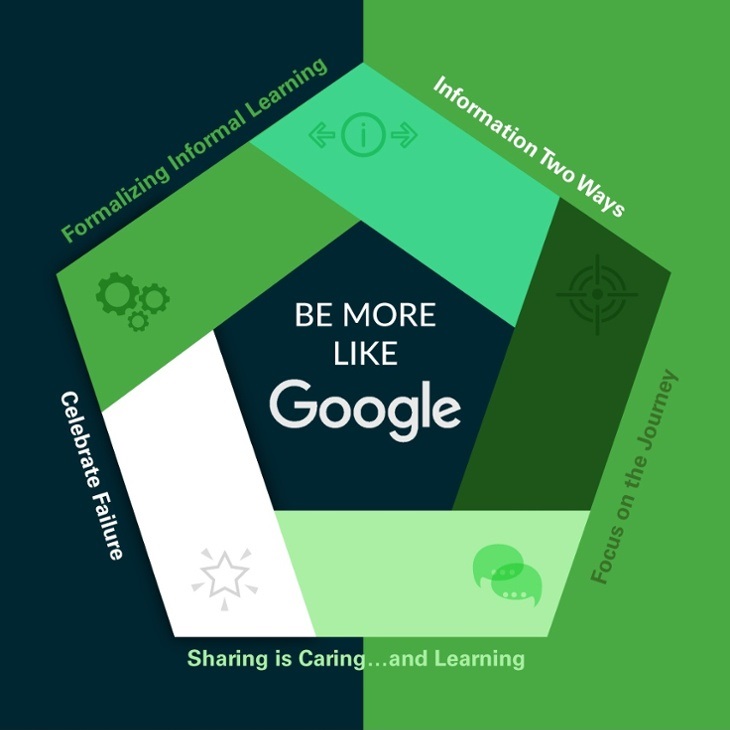
1) Information Two Ways
Remember back in school when a teacher would pass out a reminder about an upcoming school event? Ok, and then do you remember promptly losing that paper and forgetting you ever saw it? You did this for a few reasons (and not just because you were distracted by the cute guy or girl sitting next to you) 1) because the paper was a passive form of information that didn’t require you to interact or remember it and 2) because the paper had nothing to do with the information you had to remember at that particular time. It was likely passed out when you had other things to think about and also way before the actual event, so you were just handed more time to forget about it.
A learning-focused company knows that to get information to stick and be useful to its employees it must distribute material in a way that makes sense for the task and in a push/pull style.
Push it Good: When content is pushed it is given to recipients at the right time and in places where the learner will use it. For example, a computer application that helps workers while at their desk will be distributed to their desktop computer during working hours. However, a sales process or information about a new product should be designed to be viewed on a mobile device where salespeople can use it at the point of need (store, sales call, client meeting, etc.)
Pull it Back: One of the easiest and best ways to empower your workforce to learn and organize on their own is to make sure resources are managed and accessible at all times. Create an archive and ensure that your employees know how to use it and gain access to it. Something like Dropbox or Wikis could serve as a file storage. A readily available database can:
- Create Learning Opportunities: With a collected database employees from different departments can expand their knowledge base, giving them opportunities to grow and become more informed for their own sake and the company.
- Reduce Scheduling Conflicts: By giving employees the tools to self-teach this can do away with the scheduling nightmares that can arise when doing mandatory group sessions.
- Refresh: It can be difficult, if not impossible to learn everything in one or two sessions. Having 24/7 access leverages employees’ natural way of learning and allows them to look back at the material as needed.
2) Sharing is Caring...and Learning
If dogs sweat through their tongues, then what are their armpits for?
Ok, as you can see there is such a thing as a dumb question. However, no one should ever be made to feel dumb for asking it. This is especially true in a work environment where collective knowledge of the organization is most productive when it’s actively shared and encouraged to be shared. A strong learning culture is accomplished mainly by making sure employees feel safe to ask questions and talk about their ideas without feeling as if they might be called ignorant.
Leaders in the company must also make sure that differing opinions are valued and encouraged. While not every idea needs to be used, it’s important to recognize that opposition can create superior ideas through compromise. Disagreements can then be handled respectfully.
There are multiple ways for knowledge to travel within the company; vertically, laterally, between individuals, groups or even between organizations. For it to be at its maximum effectiveness, this sharing needs to be systematic and well defined. Internally focused information may have to do with conducting reviews after a project is complete while external exchange would include interviewing customers and industry experts to gain perspective. Organizing and streamlining the process makes sure the information gets to where it’s supposed to go.
Forms of knowledge sharing that might not be as obvious:
- Asking for feedback, advice, opinions and even what someone would do differently if they had your job or responsibilities.
- Asking for help. Being able to do this goes along with the idea of feeling safe and should be encouraged when needed.
- Keeping people up to date on what you’re doing and why.
3) Learn from Celebrated Failure
Falling is the first step in learning how to pick yourself up. Failure is natural and it’s also natural to want to feel embarrassed or discouraged by it. However, when we look at successful companies like Google they use failure as a stepping-stone to far better things. Google Buzz pretty much tanked, but it was used to learn how to make things better for Google Plus, which is vastly more successful.
4) Formalizing Informal and Continuous Learning
“We get only 25% or less of what we use in our jobs through formal learning. Yet, most of today’s investment in corporate education is on the formal side. The net result is that we spend the most money on the smallest part of the equation”. David Grebow, IBM Institute for Advanced Learning.
Learning is no longer considered a singular, unconnected event that happens once with no bearing on or from other parts of an employee’s job or life. Informal and continuous learning are now not just an ordinary thing but a highly encouraged part of employee growth and one that is organized into the system as much as formal learning is. Google and other organizations have actually begun giving their employees time to pursue their own interests and have reaped the benefits of a workforce that feel valued and nurtured.
A successful company doesn’t merely just provide formal training but cultivates a system that creates continuous opportunities for learning. Examples of formalized informal learning would include coaching, support tools, and training that can be requested at any time. In these cases, training is produced in bite-sized chunks that make it easy to find the exact info you need when you need it.
Check out this image provided by Bersin & Deloitte, 2013:
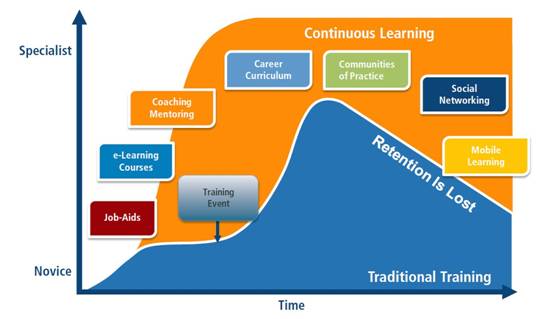
Overall, the idea of learning on the job has to turn from forced and mandatory to encouraging and self-directed. This improves workers’ ability to move up in the company and help make the entire organization successful as they, themselves, become more successful.
Source: Shiftelearning.com
- 7 chiến lược giúp quản lý đồng nghiệp cũ khi bạn trở thành sếp
- Cảm ơn các giảng viên đã đồng hành cùng chúng tôi trên hành trình học tập một năm qua!
- TalentPool đồng hành cùng TÀI NĂNG LÃNH ĐẠO "Táo bạo để vươn xa"
- Sinh viên thế kỉ 21 muốn thành công chắc chắn phải có kĩ năng làm việc chuyên nghiệp
- Khởi động dự án Xây dựng khung năng lực đào tạo cùng EVN CPC

CERTIFICATIONS FOR TRAINING PROFESSIONALS
Most certification eligibility requirements include several years of experience in a performance improvement and facilitating field.
The following table provides a list of some of the most recognized certifications for training professionals

The 7 Types Of Power That Shape The Workplace
Power comes in many different forms, and leaders need to learn how to handle each type.
"Power tends to get to people's heads," psychologist Nicole Lipkin tells Business Insider. "We're not really trained to handle power well."

TAKE THE MYSTERY OUT OF MARKETING YOUR LEARNING FUNCTION
You already have all it takes to be a great marketer of training. You just need to fine-tune your focus on knowing your audience and building relationships throughout your organization.
Article Author:
By Melissa Smith and Maria Chilcote, Managing Partners, The Training Clinic
Marketing is one of those business skills that appear to have eluded many of us in the Learning and Development (L&D) field.