
MANAGE TRAINING PROJECTS
Project management is a critical skill for the training profession. It enables us to create the solutions so critical to the success of
the organizations we support. BY ROSS TARTELL, PH.D.

In 2015, Training magazine published an article about the importance of project management as part of a trainer’s responsibilities. In that article, Wolters Kluwer Global Vice President of Talent Development Katie McSporran noted, “Whether the initial request is for a needs assessment, training/talent strategy, training program/curricula, implementation support, and/or performance consulting, project management is a fundamental competency for scoping and planning the work, gaining alignment on approach and commitments, and managing expectations” (https://trainingmag. com/trgmag-article/accidental-training-manager). Things haven’t changed since 2015. Great execution saves time and money—and increases performance. Here’s how it’s done: The typical training project has four steps connected by feedback loops that help you recalibrate any of the previous steps:
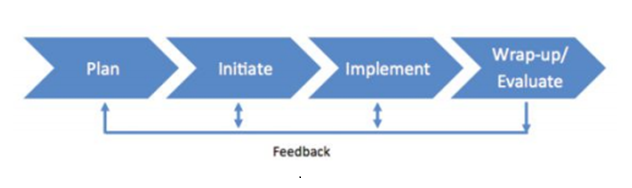
PLAN
Good up-front planning ensures that the project is focused on a realistic solution and defines the boundaries of the effort, minimizing the “scope creep” that is a common pitfall. The planning phase must answer the following questions:
- What is the project rationale? What problem or opportunity will the effort resolve or achieve? What are the project goals/ deliverables? Are the deliverables to provide information, give a recommendation, or implement a solution?
- Who is the client/sponsor? Who gives approval and what is the approval process? Who are the stakeholders affected by this project?
- When does the project need to be finished? What is the sequence of project steps and milestones that create the project plan and calendar?
- What resources, such as people, budget, and other assets (e.g., meeting space, technology, outside expertise), are needed to ensure success?
Planning stage outcomes are:
- Identification and agreement on the resources, logistics, and project plan
- Well- defined outcomes with support and buy-in from key project stakeholders
- Approval to proceed
INITIATE
Now you’ll need to create the implementation team, with guidance from the sponsor. Great teams have the necessary technical competence, or access to the specialized knowledge, to move the project ahead. In addition, team members need organizational permission to dedicate the required time, and must have the motivation and teamwork skills to work together. The second step is team chartering and launch. The project team needs to understand and commit to the project goals, team roles, and the rules governing how to work together. Common tools used in this phase are the GRPI Model (Goals, Roles, Processes, and Interpersonal Relationships) to help diagnose issues affecting team performance, and the RACI Chart (Responsibility, Authority, Consulted, Informed) to clarify roles and decisionmaking responsibilities. (Visit www.trainingmag.com for my How-To articles on these topics.) This stage also includes any needed revision of the project plan, based on feedback gathered during team creation and project launch.
IMPLEMENT
There are three keys to success in this stage. First, an operating rhythm helps the team know when they will meet, how to conduct meetings, and what they will do to execute the plan. Second, contingency planning keeps critical milestones under control when inevitable problems arise. Third, stakeholder analysis enables the Training professional to focus communications and manage politics.
WRAP-UP AND EVALUATE
Conduct a project briefing with the project sponsor and client to review the project purpose, outcomes, follow-on actions, and lessons learned. Also reallocate remaining resources and inform key stakeholders of the final project status. Project management is a critical skill for the training profession. It enables us to create the solutions key to the success of the organizations we support.
* Ross Tartell, Ph.D., is currently adjunct associate professor of Psychology and Education at Columbia University. Dr. Tartell also consults in the areas of learning and development, talent planning, and organization development. He received his M.B.A. in Management and his Ph.D. in Social Psychology from Columbia University. He formerly served as Technical Training and Communications Manager – North America at GE Capital Real Estate.
* Source: Training magazine March/ April 2018
- 7 chiến lược giúp quản lý đồng nghiệp cũ khi bạn trở thành sếp
- Cảm ơn các giảng viên đã đồng hành cùng chúng tôi trên hành trình học tập một năm qua!
- TalentPool đồng hành cùng TÀI NĂNG LÃNH ĐẠO "Táo bạo để vươn xa"
- Sinh viên thế kỉ 21 muốn thành công chắc chắn phải có kĩ năng làm việc chuyên nghiệp
- Khởi động dự án Xây dựng khung năng lực đào tạo cùng EVN CPC

CERTIFICATIONS FOR TRAINING PROFESSIONALS
Most certification eligibility requirements include several years of experience in a performance improvement and facilitating field.
The following table provides a list of some of the most recognized certifications for training professionals

The 7 Types Of Power That Shape The Workplace
Power comes in many different forms, and leaders need to learn how to handle each type.
"Power tends to get to people's heads," psychologist Nicole Lipkin tells Business Insider. "We're not really trained to handle power well."

TAKE THE MYSTERY OUT OF MARKETING YOUR LEARNING FUNCTION
You already have all it takes to be a great marketer of training. You just need to fine-tune your focus on knowing your audience and building relationships throughout your organization.
Article Author:
By Melissa Smith and Maria Chilcote, Managing Partners, The Training Clinic
Marketing is one of those business skills that appear to have eluded many of us in the Learning and Development (L&D) field.